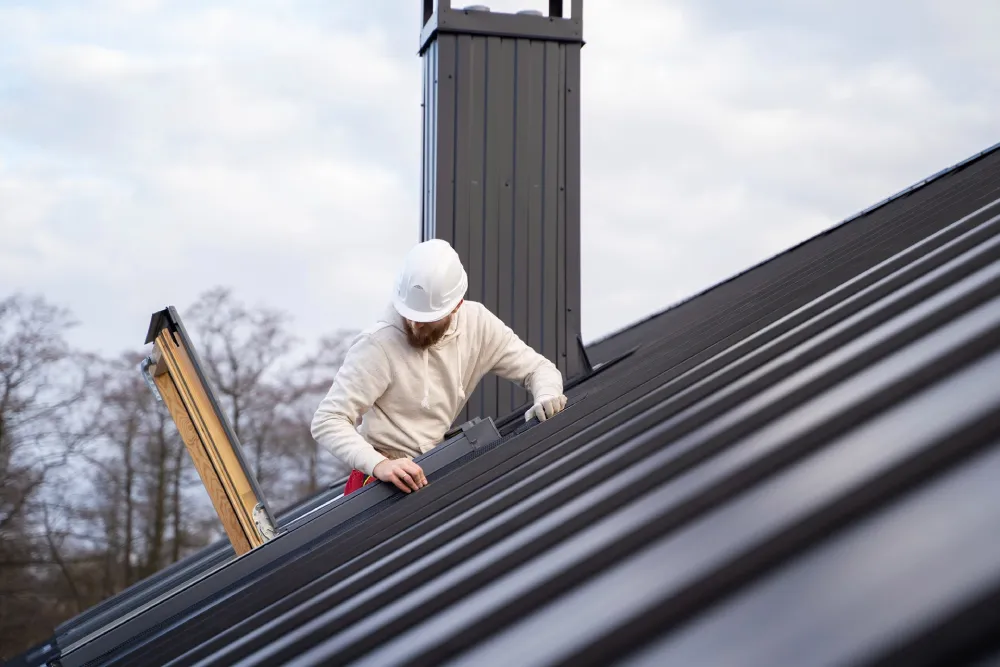
An industrial roof carries more than weather. It supports heavy mechanical units, absorbs regular foot traffic from technicians, and in some plants takes grease or chemical exhaust each day. A successful Maryland industrial roof installation begins with what happens inside the building, long before any membrane is discussed.
The Work Inside Shapes the Roof Above
A distribution center and a metal fabrication shop may share the same footprint, yet their roofs endure entirely different stresses. Experienced industrial roofing contractors in Maryland study the operation, its rooftop equipment, and its exhaust before recommending any system. That study prevents costly mismatches.
Climate adds another layer. Summer heat ages dark surfaces quickly, winter temperature swings test each seam, and coastal storms bring wind uplift. Sound industrial roof construction answers all of it through membrane color, insulation, attachment method, and drainage design.
Operating Variables That Shape the Specification
These details govern each decision that follows in a Maryland industrial roof installation. Documenting them early keeps the specification accurate and protects the budget from expensive surprises once work is underway.
- Foot traffic, including how often technicians service rooftop units and which paths they use.
- Exhaust that releases grease, oils, or chemicals onto the surface.
- Heat generated inside the building and the cooling load it creates.
- Production schedules that may rule out a full tear-off.
- Expansion plans that could call for new industrial roof construction on an adjoining wing.
Three Facilities, Three Different Roofs
No single system wins everywhere. EPDM, TPO, torch down, hot tar, metal, and coatings each have a natural home, and seasoned industrial roofing contractors in Maryland pair them with the facilities where they perform best.
The profiles below cover three of the most common situations. Each reflects the conditions that define industrial roof construction, from summer heat to rooftop equipment that never shuts off, and each pairs a facility type with the system that suits it.
Manufacturing Plants With Heavy Rooftop Traffic
Plants with large HVAC units, exhaust fans, and frequent service visits need a roof that tolerates boots, tools, and dropped parts. Puncture resistance should lead each conversation about a Maryland industrial roof installation in this setting.
Multi-Ply Layers Built for Boots and Dropped Tools
Hot tar built-up roofing layers bitumen and felts beneath protective gravel, while torch down systems fuse a modified bitumen cap sheet to a base layer. Both withstand heavy traffic, so many industrial roofing contractors in Maryland favor them for busy plants, though bitumen softens under grease and exhaust zones need containment.
Distribution Warehouses With Vast Roof Areas
Large warehouses carry enormous roof surfaces that absorb summer heat. Each square foot affects cooling costs, so reflectivity and efficient installation drive sound industrial roof construction in Maryland on these buildings.
Reflective TPO Across Acres of Open Roof
TPO is a single-ply thermoplastic membrane with heat-welded seams and a bright surface that reflects sunlight. It installs efficiently across large, open roof areas, making it a strong candidate for a cost-conscious industrial roof installation.
Facilities That Cannot Pause Production
Some operations cannot absorb the noise, debris, and disruption of a full tear-off above active production lines. For these plants, conventional industrial roof construction in Maryland is often the harder path.
Coatings Renew the Roof Without a Tear-Off
When the existing deck and insulation are sound, a silicone, acrylic, or elastomeric coating can be applied over the current roof while work continues below. Skilled industrial roofing contractors first cut out blisters and reinforce cracks with fabric and mastic, then apply the finished coating.
Industrial Flat Roofs Are the House Specialty
Commercial and industrial flat roofs are the specialty Angelo & Son Roofing LLC has built its name on. As one of the established industrial roofing contractors in Maryland, we install single-ply, multi-ply, metal, and coating systems with our own in-house crew, and we never subcontract a single task.
Each system is tailored to the facility’s budget and timeline, and Angelo & Son Roofing LLC keeps managers informed from mobilization to the final walkthrough. Materials come from trusted names such as Firestone and GAF, and each Maryland industrial roof installation is specified around the way a plant operates.
FAQ’s
1. What is the most durable roof for an industrial building?
Multi-ply systems such as hot tar built-up roofing and torch down membranes hold up exceptionally well under heavy foot traffic.
2. Is TPO a good fit for warehouses?
Yes, its reflective surface and heat-welded seams suit large warehouse roofs that need lower cooling costs.
3. Can an industrial roof be renewed without stopping operations?
A coating system applied over a sound roof often allows production to continue underneath.
4. Does grease exhaust damage roofing membranes?
Yes, grease and oils degrade some membranes, so exhaust zones need resistant materials and containment.
5. Which roofing systems does Angelo & Son Roofing LLC install? EPDM, TPO, torch down, hot tar, metal, and coating systems for commercial and industrial buildings.